The History of Code(ing)
Discover how punch cards, early machines, Assembly, and C shaped modern software - and how code evolved from physical instructions to portable digital logic.
The History of Code(ing)
chicken and egg….in a technical blog?
So a lot of people interconnect coding and computers, as they naturally should, but if you think about it closely, it's like a chicken or egg question (chicken believer btw). In reality, you can't have a computer without coding... and you can't have coding without a computer... right?
Well, that's where we can safely burst this bubble and come to a conclusion: coding predates computers, and that too by a long shot.
It began in the 1800s with the textile industry.
And how?
Punch cards.
They told the machine where to put the thread. Literally - see this hole, put in the thread. It was the first instance of making a machine bend to your will.
The control we so crave over machines was born here.
1801 - The Jacquard Loom: Joseph Marie Jacquard uses punch cards to automate fabric patterns. This is the first time "data" (holes in paper) tells a machine what to do.
The great binary logic is born.
the first leetcoder
Then in 1842 came Ada Lovelace, who, building on Charles Babbage's designs for the Analytical Engine - a machine he claimed could perform complex computations - wrote what is now considered the first algorithm intended for a machine, and possibly the first DSA algorithm??????
Although the computer itself was never built in her lifetime, the title of the world's first programmer was bestowed upon her (leetcoder too).
Before machines existed, the idea of instructing them already did.
how holes became logic
We typically count using the decimal or base 10 system of ten digits.
When we run out of digits, we repeat with a prefix, which I assume everyone knows already (I hope).
0,1,2,3,4,5,6,7,8,9,10,11,12…. see.
But we also know 0 and 1 is where it's at, and literally everything is 0 and 1… the beloved cat memes we so love are 0 and 1 too.
Now, people whose attention spans are cooked might have already put 2 and 2 together and figured out how a punch card works, but for others like me still wondering, here it is.
Think of them like OMR sheets we used to give in an exam.
You have a question where the correct answer is option C. What do you do?
You scribble your way into the 3rd hole marked C. Then the computer reads it using a scanner, detects light passing through the other options, but not through C, and marks your answer.
+4 marks awarded. Or -1 if you're giving the exam with my luck.
Now imagine each question is an index - 1, 2, 3 - and the options are numbers, alphabets, or symbols. Our beloved fundamental characters.
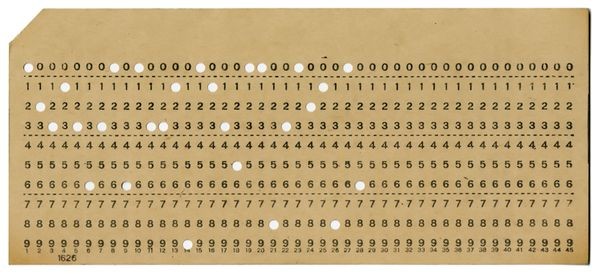
You punch out the hole of the character you want and feed it into the machine.
The machine runs electrodes through each hole, each index, and if current passes through because paper isn't blocking it, that's a 1. If it doesn't, that's a 0.
check them out and play with them here - http://kloth.net/services/cardpunch.php
Information had now become physical.
the man whose work made the pad think
Then came along Herman Hollerith.
You might not know him, but you definitely know his banger of an invention - IBM. (ThinkPad reach farmers... yeah, this is the guy you thank.)
He developed a tabulating machine that used punch cards for instructions, and technically, the coding we know today was born.
This machine was used for the United States census. You could not only calculate people but also sort them.
Sorting - as we know it - was born here. (yeah f u bubble sort)
For the first time, machines didn't just follow instructions. They processed information, which paved the way for the processors we know today.
the intercontinental machine war
Then came the 1940s, when the world was locked into one brutal focus: World War II.
At the peak of the conflict, both sides raced for smarter weapons and even smarter machines. Necessity pushed innovation into overdrive.
This time, the Germans reached the milestone first.
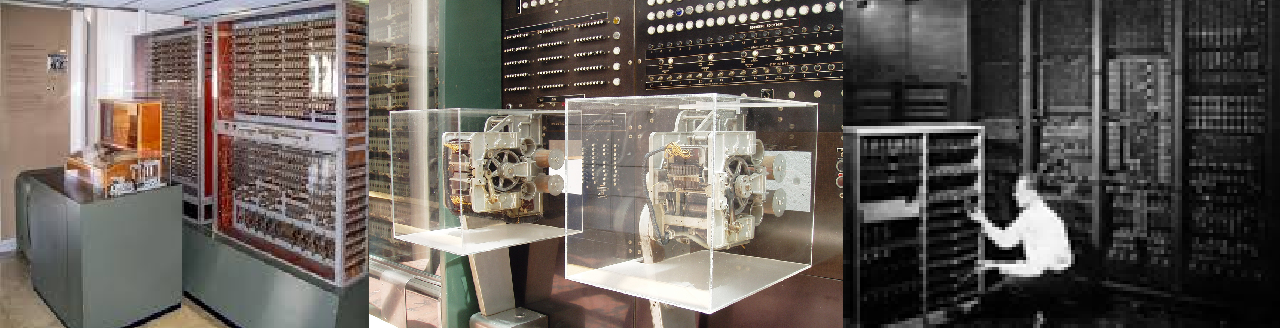
In 1941, they unveiled the Z3 computer - the first fully functional, automatic, programmable digital computer. It handled complex engineering calculations humans simply couldn't keep up with anymore… this became the backbone of the German air force, performing their calculations for them.
Machines were no longer assisting thought. They were replacing human limitation.
And then, freedom fights back.
In 1944, we get the American Harvard Mark I - a 50-foot electromechanical giant running on paper tape instructions and relentless precision. It could execute long automatic calculations without human intervention.
Experimental computing had now entered practical reality.
Then came 1945 and ENIAC - the first truly general-purpose electronic computer.
Fast for its time. Brutal to operate.
Programming meant physically rewiring cables and flipping switches like a giant telephone exchange.
No screen. No keyboard. Just logic, patience, and a whole lot of sweat.
assembly assemble
Before the programming languages we know today and love so dearly were born, there was the Assembly era.
As computers in the late 1940s grew more complex, writing raw machine code became unbearable.
Engineers made mistakes. Debugging was painful. Programs took forever to build.
So they created a symbolic layer over machine instructions — Assembly Language (yeah, the one I'm still scared of).
Instead of:
10110000 01100001
You could write:
MOV A, 97Same instructions, but now way less suffering. I can't imagine what pre-assembly suffering was if assembly itself was considered a relief.
Early assemblers began appearing in the 1950s. This marked the shift from hardware wrestling to actual software thinking.
But Assembly was brutal in its own way:
- Every processor had a unique instruction set
- Zero portability
- Optimization was manual
- Memory was microscopic
- One wrong opcode = crash city
Writing Assembly wasn't programming, but more of a negotiation with the hardware.
This mindset peaked with the Apollo Guidance Computer. Code wasn't stored digitally - it was physically woven into memory by hand. aka rope memory.
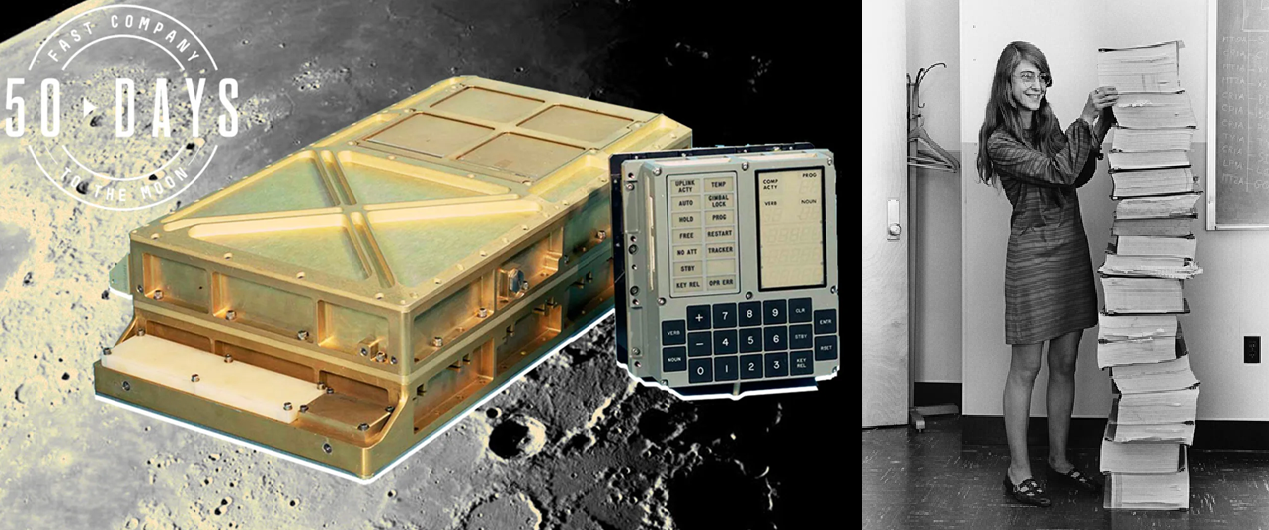
Engineers wrote Assembly. Factory workers threaded wires through magnetic cores to represent bits.
A single mistake could put a moon mission at risk.
No patches. No updates. No Version Control. No Ctrl+Z.
This era forced programmers to think like the machine:
- Memory cycles mattered
- Instruction counts mattered
- Power consumption mattered
- Timing errors could be fatal
Assembly was the last era where programmers truly understood every electron their code touched.
Try telling this to the matcha-drinking, MacBook-using, Cursor user vibe-coding their way through problems.
if it ain't broke, don't fix it
Then in 1954 came the big leap.
At IBM, the invention of FORTRAN (Formula Translation) changed everything. For the first time, humans could write instructions closer to math than machine code and let the compiler handle the ugly translation.
It quietly became the foundation for how modern languages think about structure and abstraction.
And in true developer fashion - if it ain't broke, don't fix it - FORTRAN is still in use today.
Then in 1959 came COBOL, designed for business, finance, and administration. While FORTRAN ruled scientific computing, COBOL became the language that ran governments, banks, and massive institutions - and honestly, still does in more places than people like to admit. Your ATM probably runs on machine logic influenced by code written decades ago.
the breaking point
By the late 60s, hardware was getting faster, but software was collapsing under its own weight.
Projects ran years late. Budgets exploded. Code became spaghetti logic where fixing one bug created ten more. (kinda sounds like my code)
This was the Software Crisis.
Computers had become too complex for humans to manage using just Assembly.
We needed something higher level - a language readable enough for humans, but precise enough for machines.
Something we could dictate without babysitting, something we could rely upon, and something we could run on every machine without breaking them - which, in case you didn't know, we couldn't do with Assembly… as it was, and still remains, hardware-specific.
the modern programming C's the light
In the midst of this crisis, at Bell Labs, Dennis Ritchie created C (my goat).
C was the Goldilocks language. High-level enough to be readable. Low-level enough to talk directly to hardware. Most importantly, it was portable.
For the first time, you could write code once and run it on different types of computers.
Ritchie and Ken Thompson then did something legendary.
They used C to rewrite the Unix operating system.
Before Unix, operating systems were clunky and tied to specific machines. Unix was modular, stable, and adaptable. Because C made Unix portable, it spread rapidly through universities and research labs.
This wasn't just another tool.
This was the moment software became independent of hardware.
Every Mac, every Linux server, every Android phone today traces lineage back to this shift.
The way you write code now - abstracted, portable, layered - exists because we once had to punch holes in paper just to make a machine listen.
And that's the story of how control turned into language - and language turned into code.
for those looking for more
check this video out - The History of Computing
wikipedia is also really helpful - Computer History